Early voting in North Carolina starts on Thursday, October 15, and ends at 3 p.m. on Saturday, October 31. Election Day is Tuesday, November 3. For those 18 days, campaign volunteers will stand outside polling places across the state, handing out cards and asking people for their votes. Campaigns that do this well plan it ahead of time.
- They know the rules at each site.
- They choose their sites carefully.
- They keep track of who is covering each shift.
Poll greeters are campaign volunteers. They are different from poll workers, whom the county board of elections hires to run the voting place, and from poll observers, whom the political parties appoint to watch the voting inside. Greeters work outside, in the area the county sets aside for campaigning. That area begins at the edge of a buffer zone that extends 25 to 50 feet from the entrance, and your county board of elections posts the exact boundaries for each site on its website.
Poll greeting matters
Poll greeting matters for candidates up and down the ballot. Many voters decide on their U.S. Senate candidate long before they get to the polls, but they are less likely to know about judicial, sheriff and commission candidates. For those voters, the card your greeter hands them will be the only thing they learn about you before they vote.
Poll greeting also reaches only people who are voting. No wasted effort. Every person who walks past your greeter is a certain voter.
Choosing your sites
Most campaigns don't have enough volunteers to cover every site for every hour. Decide which sites matter most before you start recruiting. Early voting and Election Day call for different approaches.
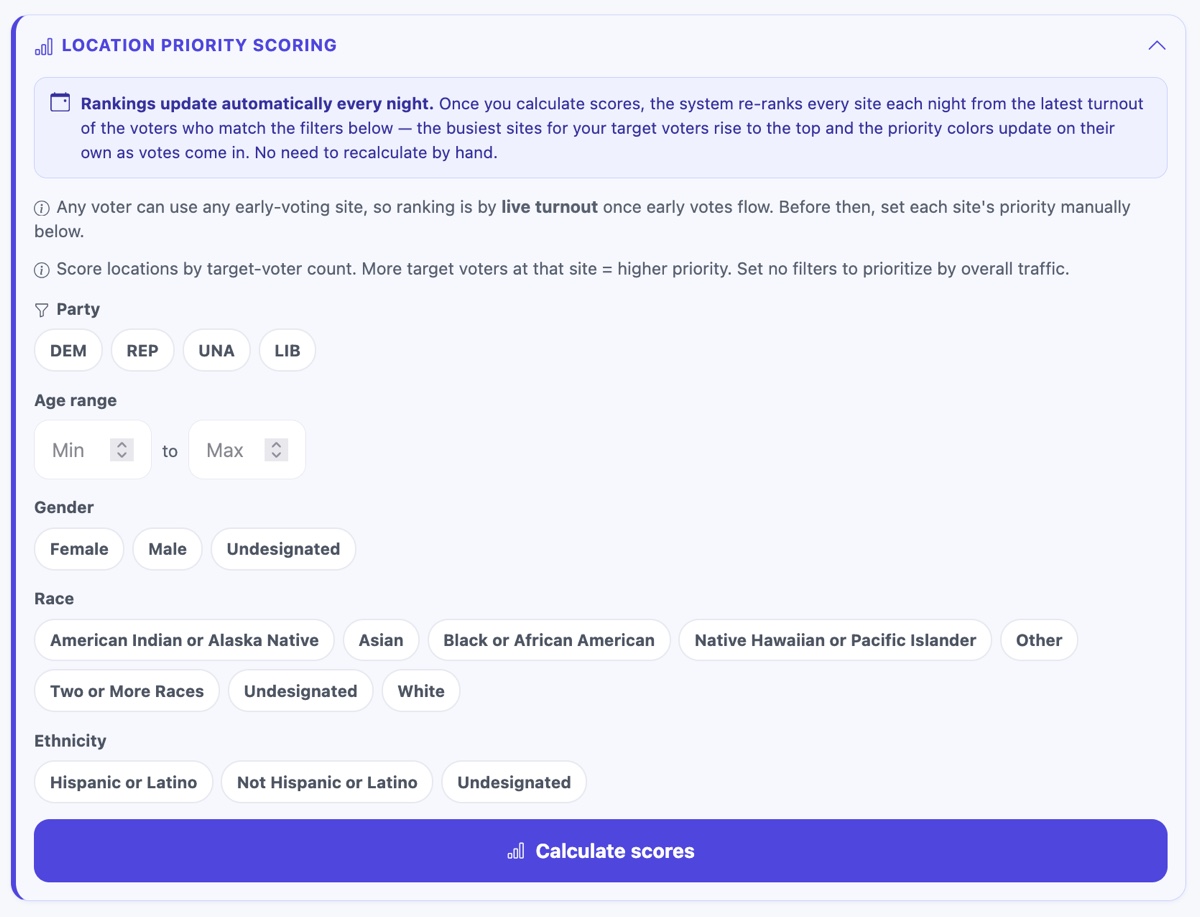
During early voting, a registered voter can vote at any early voting site in their county. The precincts around a site won't necessarily tell you who will vote there. You can see where different types of voters are voting though once early voting is underway if you have a data platform that provides that insight. With this information, you can adjust your priority locations on a daily basis.
On Election Day, each voter must vote at the polling place for their own precinct. That lets you estimate who will come to each site. Rank your Election Day sites by how many of your target voters live in each precinct and how often those voters have voted in past elections. A small precinct where your voters reliably vote can be worth more than a large precinct where they rarely vote.
I built the Poll-Greeting Scheduler to rank sites this way. It already has every polling place in North Carolina loaded. It ranks Election Day sites by the expected turnout of the voters you target, based on party, age, and other criteria you choose. It ranks early voting sites by the number of people voting there, updated each morning.
 Click or tap to enlarge
Setting up shifts
Counties set their own early voting hours, and sites in the same county can keep different hours on different days. Weekend hours are often shorter, and early voting ends at 3 p.m. on the last Saturday. On Election Day, every polling place is open from 6:30 a.m. to 7:30 p.m.
Shifts of two to three hours are easier to fill than long ones. Fill the busiest times first: the first hours of the morning, lunchtime, and late afternoon. The first and last days of early voting are usually busy, and so is the morning of Election Day.
Tracking all of this in a spreadsheet gets hard quickly. A county with 20 early voting sites open for 17 days, with three shifts a day, has more than a thousand shifts, and many of them have different hours. The Poll-Greeting Scheduler loads each site's early voting hours from the state's data and creates all the shifts at once.
Recruiting greeters
Give volunteers one link they can open on a phone to choose a site and a time. Share it by email, text, and social media, and print a QR code for the table at your events.
When someone signs up, send a confirmation with the site address and shift time. The day before the shift, send a reminder with directions and a list of what to bring. Make it easy to cancel, too. A volunteer who can't come should be able to release the shift in one step, so you hear about the opening while there's still time to fill it.
The campaignmanager.us scheduler sends the confirmations and reminders automatically. Greeters sign up on any phone without an app or a login, and they can cancel from the email.
Preparing your greeters
Before each greeter's first shift, send them the county's notice for their site so they know where the buffer zone ends. Give them a sentence or two to say, such as: "Hi, I'm volunteering for Jane Smith. She's running for district court. Would you like a card?" If a voter doesn't want to talk, the greeter should let them pass.
Greeters need palm cards, a sample ballot if your campaign or party has one, water, a folding chair, and clothes for the weather. Late October in North Carolina can be warm at midday and cold by evening.
Your greeters will stand near volunteers from other campaigns. Most of the time, everyone gets along. If an argument starts, your greeter should stay calm, walk away, and report anything serious to the election officials at the site. Some county parties train greeters to handle these situations. The Wake County Democratic Party offered de-escalation training this year. Make sure someone from your campaign answers the phone during every hour the polls are open.
Keeping track once voting starts
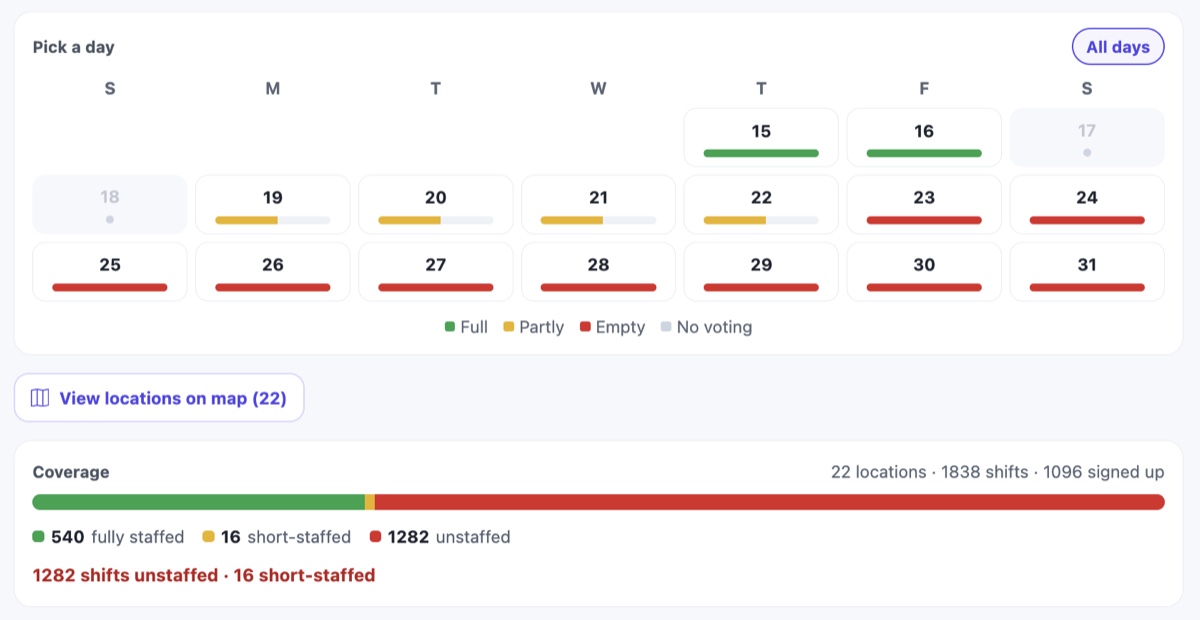
Your schedule will change once voting starts. Volunteers get sick or have conflicts, and some sites are busier than you expected. Check every day which of the coming shifts are fully covered, partly covered, or empty. Move greeters from slow sites to busy ones, and send your signup link again to fill the empty shifts at your most important sites.
The Poll-Greeting Scheduler's coverage view shows each site and day, colored by whether the shifts are full, partly filled, or empty. It also lists each site's rank, so you can see which gaps to fill first.
 Click or tap to enlarge
Early voting starts in less than three weeks. If you start this week, you have enough time to choose your sites, set up your shifts, and recruit your greeters.
I built the Poll-Greeting Scheduler for this work. It covers every polling place in North Carolina, for early voting and Election Day. You pay once for the whole election, starting at $499, and you can ask for a full refund within seven days. You can sign up here, or email me with questions about your race.