Some elections produce a story people can feel before anyone can prove it. You hear it on the news, you hear it from the party, and you hear it from your volunteers. Whether it is a source of hope or dread for your campaign, vibes are a poor substitute for analytical planning.
Smart campaigns look for actionable data. Here are two examples telling the same story: Hispanic voters are knocking it out of the park.
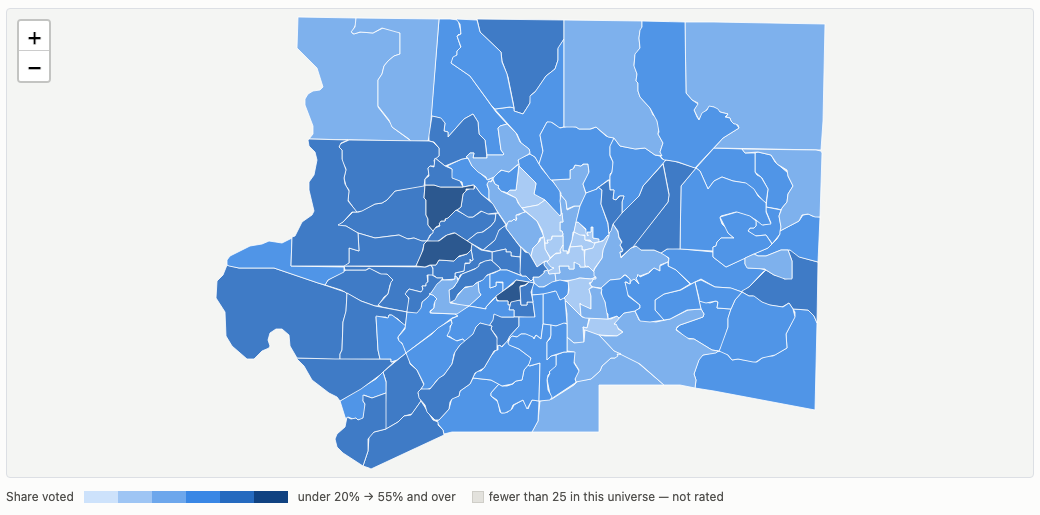
Forsyth County — 108 precincts, 240,856 registered voters, 43.4% already voted. Tap the map to filter it by party, race, ethnicity or age.
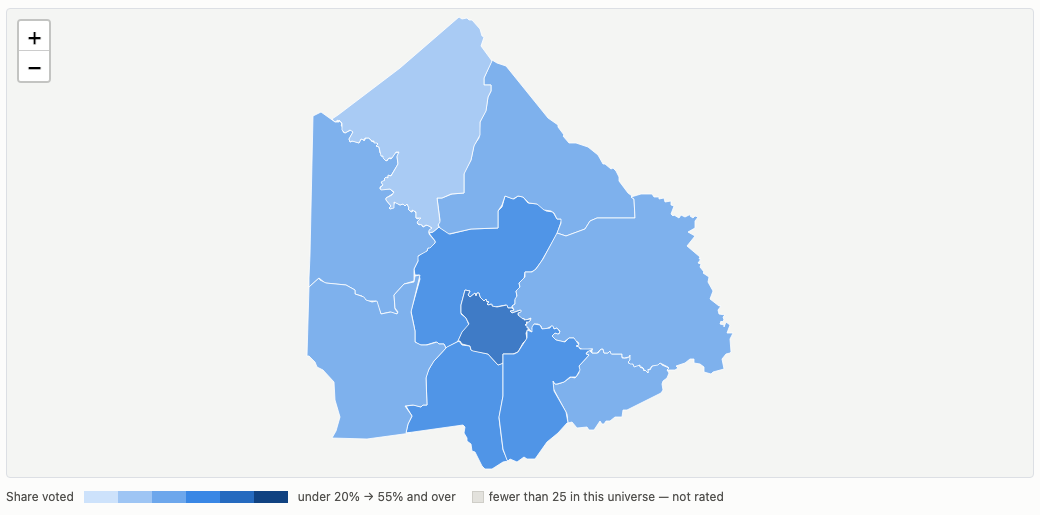
Greene County — 10 precincts, 9,954 registered voters, 38.1% already voted. Tap the map to open the same tool on Greene.
Take a look at the percentage of currently registered voters who voted early this year and in 2022.
| Forsyth County | Voted early, 2022 | Voted early, 2026 | Change |
|---|---|---|---|
| Hispanic voters | 18.5% | 37.9% | +19.4 points |
| Black voters | 41.2% | 52.8% | +11.6 |
| White voters | 44.3% | 50.5% | +6.2 |
| Registered Democrats | 47.1% | 57.8% | +10.7 |
| Unaffiliated voters | 36.7% | 45.5% | +8.8 |
| Registered Republicans | 39.9% | 44.3% | +4.4 |
Hispanic participation in Forsyth has more than doubled. The Democratic lift runs more than twice the Republican one. Those two sentences are the national story, and we can see them happening in Winston-Salem.
It is participation, not preference — which is what makes it useful
The voter file records whether a person voted. It never records how. A registered Democrat casting a ballot is not a vote for a Democrat, and a county where Hispanic turnout doubled has told you nothing about who those voters chose.
For a Republican candidate in Forsyth County, that table was the most useful thing available on the first of November, because it said their own voters were up 4.4 points while everyone else's were up eight to nineteen. A campaign reading it that morning was not reading a morale problem. It was reading a list of names, with two days left to work them.
For a Democrat, the same table was a warning against believing good news. A lift is not a win, and the voters who have already cast a ballot are the ones to stop calling — which is a thing worth knowing while the phone bank is still running, and worth nothing afterwards.
This is not a big-county story
Greene County has 9,954 registered voters and ten precincts. The same measurement there:
| Greene County | 2022 | 2026 | Change |
|---|---|---|---|
| Hispanic voters | 6.8% | 28.5% | +21.7 points |
| Black voters | 48.5% | 56.7% | +8.2 |
| White voters | 36.2% | 39.0% | +2.8 |
The pattern is sharper in the small county than the large one. A shift of that size among 10,000 voters can decide a race.
Unfortunately, the campaigns least able to afford a wasted weekend are the ones most often working on instinct, against an opponent working on the same instinct, while the real answers sit in the data.
Opening the voter file is not the hard part. Visualizing it and making it actionable is.
The file arrives as a raw export with no geocoding attached to addresses, no precinct boundaries, and no indication of which of 2,632 precinct records belong to you. Answering a single question — which Hispanic voters in my district have not voted yet, and what are their numbers — means joining several files, knowing that 2022 labels early voting one way and 2024 labels it another, and rebuilding the whole thing tomorrow morning when the State publishes again.
Campaigns do not ignore data because they are lazy. They ignore it because the work is a full-time job requiring expertise and time.
That is the part we do. The CampaignManager platform rebuilds from the State's file every morning, wraps a whole bunch of useful visual tools around it, and hands a candidate actionable answers rather than the ingredients.
Throw in volunteer coordination, scheduling, mailing lists, calling lists and canvassing maps, and you have the whole operation in one place. Candidates tell me they have not found that anywhere else.
Ready to put it into action? I would love to talk to you. Just drop me a line:
Roch Smith, Jr admin@campaignmanager.us
CampaignManager.us gives NC candidates the voter data, canvassing maps, and calling lists to run effective campaigns.
Figures from the North Carolina State Board of Elections file imported at 6:00 a.m. on November 1, 2026, counting active registrants only, and frozen at that reading — an illustration of what the file showed that morning, not current turnout. The 2022 comparison counts only voters registered before November 8, 2022, so that the same people are measured in both elections.