There are ten operations a serious local campaign runs in the final 100 days before Election Day. Does yours have them all covered? If some are lagging, don't panic — shoring up your campaign now is the whole point. One hundred days is enough time to set your campaign on a course for success.
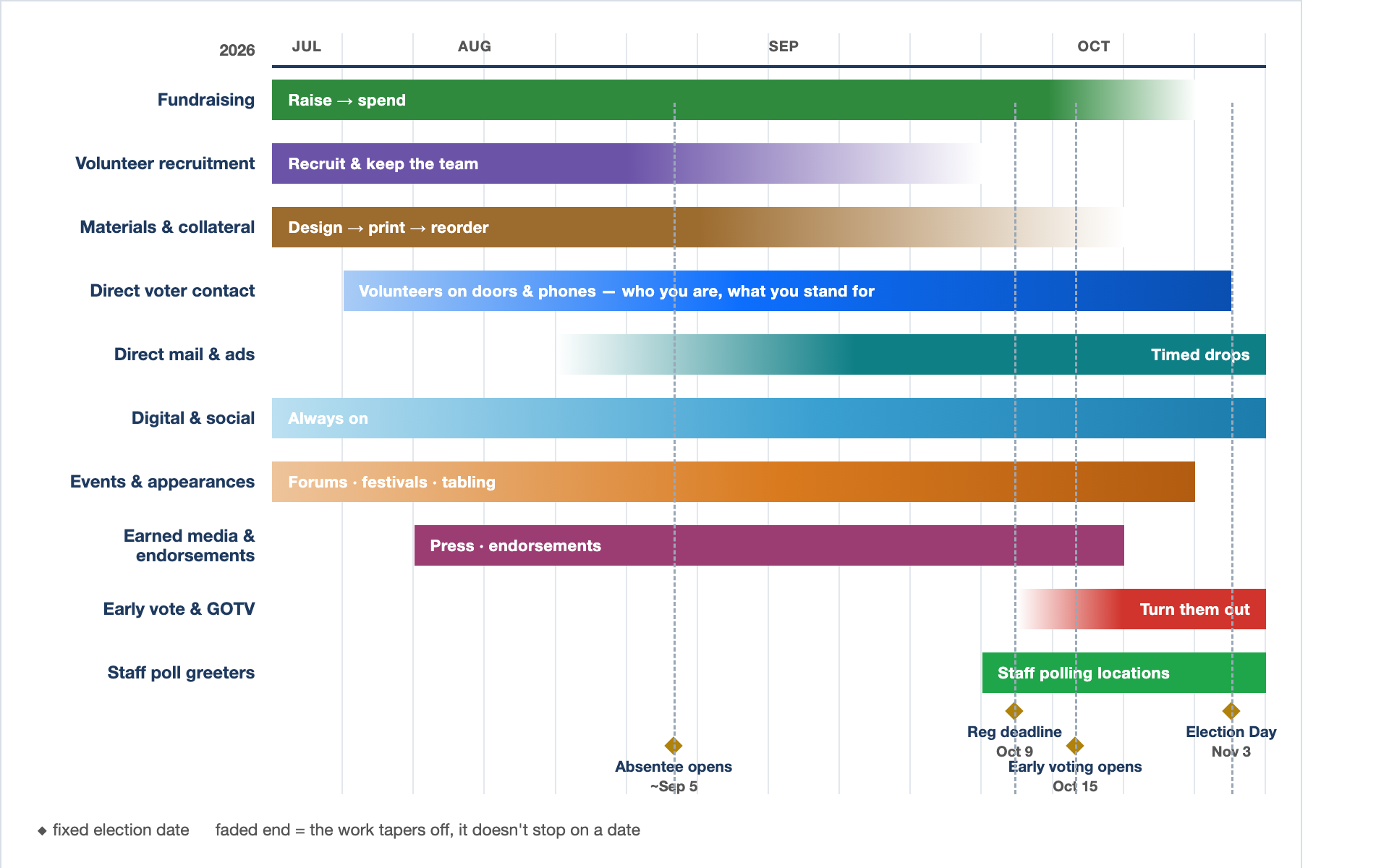 Click or tap to enlarge
Not sure who your voters are or how to reach them? Working that out is vital, and it's where I can help — starting with a free, no-obligation 100-day plan built for your race. Ask me and I'll build one for you.
10 vital operations from now to Election Day
1Fundraising · late July → late October
Money is what turns a plan into action — it pays for the mail, the signs, the ads, the gas. Start raising on the first day, because a summer dollar does more than a late one: what you bring in now pays for the mail and ads that land in October, when voters are finally paying attention. You are your campaign's best fundraiser, so ask people directly, starting with the ones who already know you, and be specific — name the amount and say what it buys. Set a simple budget tied to this plan and spend with discipline, holding enough back for the final weeks when the same dollar does the most good.
2Volunteer recruitment · late July → October
Volunteers are what let a small campaign act like a big one — every door knocked and call made beyond what you can do yourself comes from someone who signed up to help. So recruiting never really stops: you start in the first week and keep at it, because people get busy, move, and drift away. Ask directly, and ask everyone — your own circle first, then their circles. Give a new volunteer something real to do within a few days, while the interest is fresh.
A volunteer team is only as strong as how it's organized. CampaignManager gives you a sign-up link that drops new volunteers straight onto your roster, and the tools to put each one to work from their own volunteer dashboard. Ask how it could organize your team.
3Materials & collateral · late July → mid-October
A local campaign doesn't need many kinds of materials — it needs a few good ones: yard signs, a palm card that says what you stand for, and often a mailer or two. Make everything look like it belongs together, and design for a glance, not a read. Yard signs with just your name and the office big enough to read from a moving car. Order early, because printing takes time and you want signs up and cards in hand before the real work starts. Order enough yard signs to cover your polling places on Election Day, and reorder materials as you go.
Yard signs don't move themselves. CampaignManager turns supporters' sign requests into delivery routes a volunteer can claim — and maps the night-before-Election-Day placement at every polling location, so your signs are up before the first voter arrives. Ask how it handles your sign routes.
4Direct voter contact · early August → Election Day
This is the heart of the campaign: you and your volunteers reaching voters in person and by phone — a real person saying who you are and what you stand for. It moves more votes than anything else you'll do, and it's where most of your volunteer hours belong. Start as soon as you have a few volunteers, give everyone the same short script, and work from the list your strategy points you to — the voters you need, not every door. This is the one effort that should grow all the way to the end, not level off in October. And write down how each conversation went; those notes are what you turn out in the final weeks.
Running all of this by hand — the lists, the maps, the note on every conversation — is where a campaign bogs down. CampaignManager is built to carry it: calling lists, canvassing maps, volunteer engagement and task management. Find out what it could do for your campaign.
5Direct mail & ads · late August → Election Day
A postcard or a digital ad puts your name in front of voters more than once — but it persuades less than a real conversation, so treat it as reinforcement for direct contact, not a replacement. Aim it, don't spray it. Send to the households your strategy points to, timed so the pieces land in the last few weeks when undecided voters are finally paying attention, and keep the postcard clean — your photo, your name, the office, one message. Two or three well-timed pieces to the right doors beat a single drop to everyone; the same is true of ads, where a small budget spread everywhere disappears but aimed at the right audience gets seen.
6Digital & social · late July → Election Day
A simple website and one social account are cheap and always on — a steady way to stay visible between the doors and the phone calls. But be honest about what it does in a local race: it reaches the people already following you more than it wins over new ones. Pick one place and do it well — for most local races that's Facebook — and post a few times a week: a real photo from the trail, where you'll be this weekend, one thing you stand for. Set up a website too, even a single page, so it's what a search engine turns up when a voter looks up your name and gives supporters a place to help or donate. Every post should ask for something real.
7Events & appearances · late July → late October
Showing up in person is how a local candidate gets known — the forums, the festivals, the church suppers, a table at the farmers market. People vote for someone they've met or whose name keeps coming up. Say yes to every candidate forum, go where your voters already gather, and always bring a way for people to sign up on the spot. The point of an event isn't the event — it's the follow-up a day or two later, while they still remember meeting you.
8Earned media & endorsements · early August → mid-October
Earned media is the coverage you don't pay for — a story in the local paper, a mention on the radio — plus the endorsements of people and groups your voters already trust. It carries weight because it's credible: a voter believes a newspaper or a respected neighbor far more than an ad you bought. Make it easy to cover you, because local newsrooms are thin: a short, clear announcement often gets the story, and you should return every reporter's call the same day. Go after endorsements early and ask straight out, then use them — on your cards, your website, your social. One good story or one well-known endorsement can move more votes than weeks of posting.
9Early vote & GOTV · mid-October → Election Day
Get-out-the-vote is the last job of the campaign, and a different one from everything before it. You're not persuading anyone now — you're making sure the people who already back you actually cast a ballot. In North Carolina most voters don't wait until Election Day, so your turnout push can't either: it starts in mid-October, moving your supporters to the early-voting sites as soon as they open, and keeping track of who's already voted so you stop contacting them and focus on the ones still out. Volunteers can really make a difference here. From early voting through Election Day, every voter who might support you gets a knock, a call or a ride.
This is where CampaignManager earns its keep. Who's already voted updated nightly, so your final push focuses on voters still out — no wasted knocks, no wasted calls. Learn how to put it to work for your turnout.
10Staff poll greeters · mid-October → Election Day
On the days people actually vote — the early-voting stretch and Election Day — a friendly face outside the polls is one of the last and cheapest touches you get. A volunteer handing your palm card to voters on their way in reaches people at the moment some are still deciding, and the best greeter you have is you. You can't staff every location, so put your greeters where the votes are: the busiest early-voting sites, and your highest-traffic precincts on Election Day. Cover the long days with shifts, keep it courteous and legal — stay outside the marked buffer zone — and put the slow stretches to work calling supporters who still haven't voted.
This is the shape of the plan — but a plan is only worth as much as what you do with it. CampaignManager is where these operations actually run: your voters, your volunteers, your lists and maps in one place, priced to your race and live in a day. Ask me what it would look like for your campaign — or if you'd like the plan first, tell me your name and the office you're seeking and I'll build one for your race, free. Either way, just ask.